On this page

To compare software development quotes, put the same required work beside each price, resolve missing items in writing, then add the costs for the same period. If you own a Malaysian SME and have two proposals that seem to describe different projects, the worksheet and RM example below will help you reach a like-for-like decision.
Do not treat an unstated cost as RM 0. A lower price can still be the better purchase, but only once you know what you must supply or pay for separately.
1. Set one baseline for comparison
Write down the work both quotes must cover before you compare their totals. You need the proposals, their attachments and the brief each supplier received; an email promise that changes the scope belongs with them.
For a distributor, the baseline might be: enter an order once, send the approved order to the existing accounts software, import one agreed customer file, train the staff who will use it, and hand over the materials needed to maintain it.
Include an acceptance check. For example: a sample order reaches the accounts software with matching quantities and prices; a rejected order stays visible for correction. Ask each supplier to confirm it can demonstrate this before you accept that part of the work.
If the proposals solve different problems, use the software project brief guide to settle the missing requirements. You do not need to rewrite a full specification just to clarify one connection or handover task.
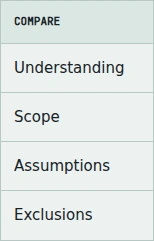
Dreamcode Solutions — software project brief guide, captured 7 Nov 2026. Category-column crop; other columns omitted for phone readability.
2. Compare software development quotes line by line
Copy this blank sheet into a document or spreadsheet. Put a requirement on each row, then record what each proposal actually says rather than what you think the supplier meant.
| Required item | Quote A: wording, status, RM | Quote B: wording, status, RM | Written answer needed |
|---|---|---|---|
| Workflow and acceptance check | — | — | — |
| Connection to existing software | — | — | — |
| Import of existing records | — | — | — |
| Training and handover | — | — | — |
| Hosting and ongoing support | — | — | — |
| One-off extras and third-party charges | — | — | — |
| Payment, changes and delivery conditions | — | — | — |
Use included, optional, excluded or unknown for each item. If a promise depends on you supplying clean records or access to another system, write that assumption beside it.
“Integration included” needs a description: which software, what information moves, in which direction, and what happens when it fails. “Support included” needs its coverage, hours and duration. Ask whether it covers fixing defects, helping users, or changing features; those are different jobs.
3. Work through two RM quotes
The following distributor, quotes and written replies are hypothetical amounts created for this worked example on 7 Nov 2026, not supplier rates, Dreamcode prices or a client result.
The owner needs an order-entry tool connected to existing accounts software. Both offers cover the same users, order checks, training and launch requirements. The differences are below.
Quote A: RM 28,000 for the build, plus RM 2,000 for the agreed customer-file import. The accounts connection is excluded and unpriced. Hosting and the agreed support package cost RM 400 a month. The proposal says nothing about source files or maintenance instructions.
Quote B: RM 36,000 for the build, agreed import, accounts connection and handover. Hosting and the same support coverage cost RM 300 a month. Its attachment names source-file access, setup instructions and company-controlled service accounts as handover deliverables.
For this exercise, both suppliers confirm that all required supplier and third-party charges are included in the stated amounts, apart from A’s unresolved connection and handover. Monthly charges start at launch and run for 12 months without a price change. Existing accounts-software charges stay unchanged and outside both comparisons; no other new licence, usage or tax amount needs adding under these example assumptions.
Completed comparison before clarification
| Required item | Quote A | Quote B |
|---|---|---|
| Order tool, agreed checks and training | Included: RM 28,000 | Included in RM 36,000 |
| Agreed customer-file import | RM 2,000 extra | Included |
| Accounts connection | Excluded; cost unknown | Included |
| Source files and maintenance instructions | Unknown; not stated | Included |
| Hosting and same support coverage | RM 400/month | RM 300/month |
| First-year position | Incomplete | RM 39,600 |
A’s known subtotal is RM 28,000 + RM 2,000 + (12 × RM 400) = RM 34,800. It is not a first-year total: two required items still lack prices.
B’s complete first-year total is RM 36,000 + (12 × RM 300) = RM 39,600 under the stated assumptions. You cannot yet say that A saves RM 4,800; that gap must also cover the unresolved work.
Completed comparison after written replies
In the example replies, A offers the same accounts connection for RM 5,000 and the same handover deliverables for RM 1,800. Its revised proposal confirms that these amounts close both gaps without changing the other charges or responsibilities.
| First-year calculation | Quote A | Quote B |
|---|---|---|
| Build and agreed one-off work | RM 28,000 + RM 2,000 + RM 5,000 + RM 1,800 | RM 36,000 |
| Twelve monthly payments | RM 4,800 | RM 3,600 |
| Complete first-year total | RM 41,600 | RM 39,600 |
B is now RM 2,000 lower for the agreed scope and period. That changes the price comparison, not the whole supplier decision. You still need confidence in who will deliver, how you will accept the work and what happens after launch.
4. Check responsibility before choosing
Ask who will leave you able to run the software. A promise of “full ownership” does not tell you whether you will receive the files, access and instructions needed for another person to maintain it.
Request a handover list covering source files, agreed rights to use and change the work, service-account control, setup instructions, data export and maintenance responsibilities. Ask the supplier to identify any restrictions on third-party components. Have your lawyer check contractual terms you do not understand.

Illustrative editorial picture, not a client or product screenshot.
Match payments to named deliverables and agreed acceptance checks. Record what you must provide, who tests the work and how unresolved defects affect acceptance. For a change, require a written description, price and effect on the delivery date before deciding whether to proceed.
Check training against the actual work your staff will do. Our guide to why projects can fail at adoption explains why a working demonstration alone does not settle that question.
5. Send the gaps back in writing
Send each supplier the rows that remain unclear, with questions it can answer precisely:
- Does your price include the accounts connection and the agreed failure-handling check? If not, quote them separately.
- What source files, access and maintenance instructions will you hand over, and what will that cost?
- What must we pay once and monthly for the first 12 months after launch? State any limits, excluded charges and applicable taxes.
- Which assumptions could change your price or delivery date, and how would we approve that change?
Update the sheet from the revised proposals. Prefer B in the worked example if both suppliers meet your delivery and handover requirements, because it covers the same work for less. Prefer A only if a verified advantage justifies the extra RM 2,000 to your business. If essential costs remain unknown, pause the selection rather than guessing them.
If neither offer fits your budget, reduce the first version’s scope and ask both suppliers to reprice it. If the comparison exposes a standard job that an existing product can handle, revisit custom software versus off-the-shelf tools.
Dreamcode’s custom solutions service covers workflow framing, integrations and maintainable handover. If you want help turning unclear proposals into a comparable scope, bring your comparison sheet to a free consultation.
Sources
- How to Brief a Software Vendor So You Get the Right Quote — Dreamcode Solutions; checked 7 Nov 2026.
- Software House for Custom Business Software — Dreamcode Solutions; checked 7 Nov 2026.
- How to Scope the First Version of an AI or Automation Project — Dreamcode Solutions; checked 7 Nov 2026.
- Custom Software vs Off-the-Shelf Tools: How to Choose — Dreamcode Solutions; checked 7 Nov 2026.
- Why AI Projects Can Fail at Adoption, Not Technology — Dreamcode Solutions; checked 7 Nov 2026.