On this page
- The status quo: demos are mistaken for progress
- Why the usual approach breaks
- The project is added beside the workflow
- Users see an answer without evidence
- The system has no clear authority
- Corrections disappear
- The old process never retires
- My thesis: build the adoption system with the AI system
- 1. A specific job
- 2. A place in the real workflow
- 3. Visible evidence and limits
- 4. A correction and exception path
- 5. Accountable ownership
- What evidence should look like
- What leaders often misread
- “People are resistant to change”
- “The model needs to be more accurate”
- “We need more training”
- “We should mandate usage”
- A better rollout sequence
- Start with one team and one job
- Run the old and new paths deliberately
- Review corrections weekly
- Expand only after the workflow is stable
- Retire duplicate work
- The prediction
- FAQ
- Why do employees avoid AI tools?
- How do you measure AI adoption?
- Should AI use be mandatory?
- Who owns adoption?
- When should an AI pilot scale?
- Ready to make the pilot usable?
An AI system can produce impressive outputs and still create no business value. The project fails when people do not know when to use it, do not trust the result, cannot correct it, or must leave their real workflow to access it.
The hard part is not proving that AI can perform a task once. It is making the capability dependable, accountable, and useful on an ordinary Tuesday.
Thesis: AI adoption is a workflow-design problem. A model becomes valuable only when people understand its role, see its evidence, can handle exceptions, and receive a better way to complete real work.

The status quo: demos are mistaken for progress
AI demos compress complexity. They use a clean prompt, a selected example, and an attentive audience. The output appears in seconds.
Production work is different. Inputs arrive incomplete. Policies conflict. Systems are slow. Customers use unexpected language. Somebody must own the result when the model is wrong.
Teams often measure prototype quality while leaving the operating questions unresolved:
- Where does the capability live?
- Who is expected to use it?
- Which cases are suitable?
- What evidence supports the output?
- Who handles mistakes?
- What happens to the old process?
The model may be ready while the organisation is not.
Why the usual approach breaks
The project is added beside the workflow
A separate chatbot, portal, or prompt library creates another destination. Staff must remember when to leave the system where the work already happens.
Optional tools become invisible under pressure. Adoption improves when the capability appears at the exact decision point and removes a real step.
Users see an answer without evidence
Fluent output can look confident even when context is missing. If users cannot inspect the source, validation, or reason behind a recommendation, they either trust too much or double-check everything.
Both behaviours are expensive.
The system has no clear authority
Can it draft, recommend, approve, send, or update a record? If nobody defines the boundary, users invent their own.
Some will treat every output as final. Others will use the system as a novelty. Consistent adoption requires a consistent contract.
Corrections disappear
When a user fixes an output but the reason is not captured, the system and process learn nothing. The same failure returns, and staff conclude that feedback does not matter.
The old process never retires
If the spreadsheet, inbox, and manual approval remain mandatory “just in case,” the AI layer adds work rather than removing it.
A transition period may be necessary. A permanent duplicate process is not adoption.
My thesis: build the adoption system with the AI system
Adoption is not a launch campaign at the end of development. It is part of the product architecture.
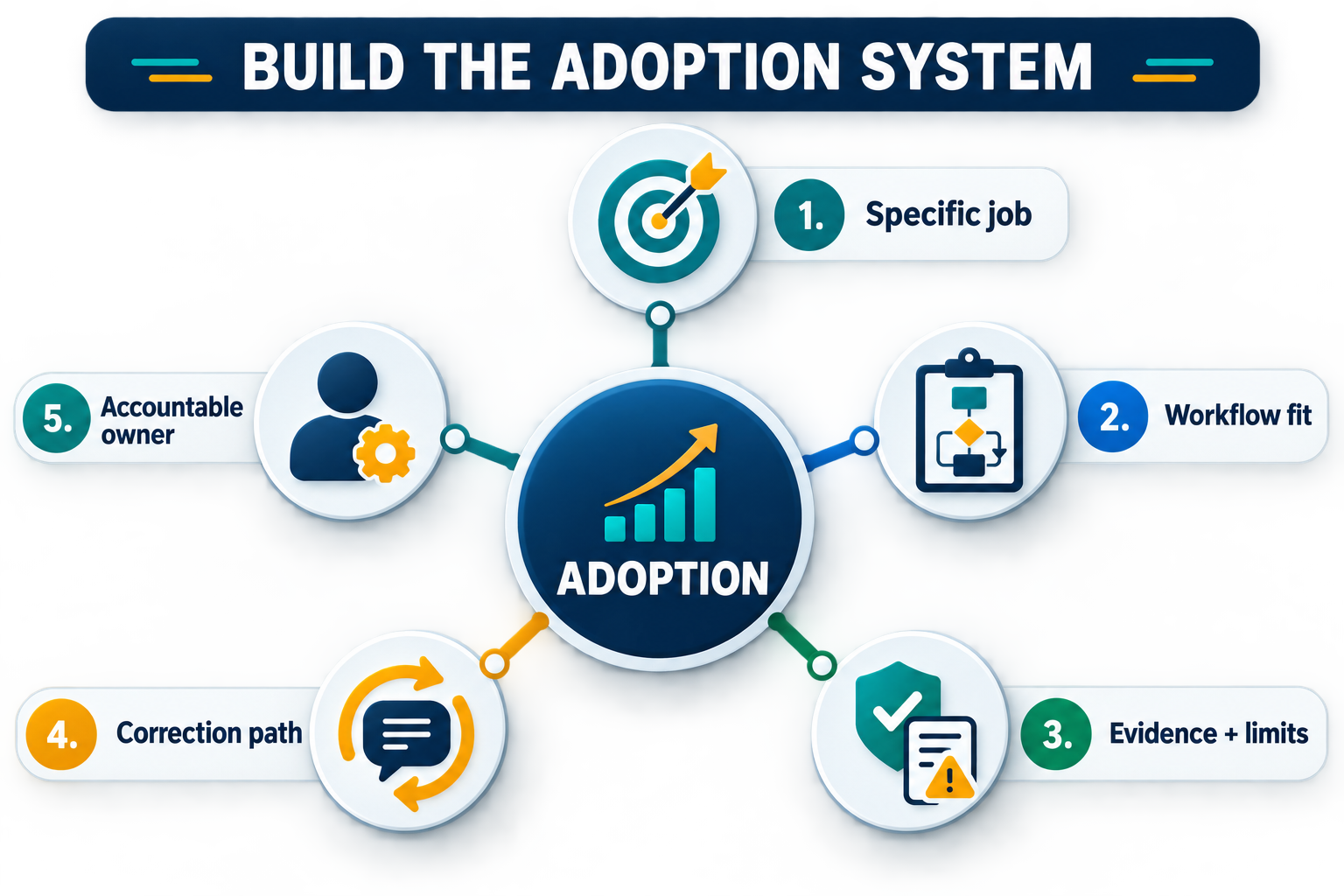
A useful adoption system includes five elements.
1. A specific job
Users should be able to complete this sentence: “I use this when ___ so that ___.”
If the answer is “for anything involving AI,” the scope is too broad.
2. A place in the real workflow
The capability should appear where the trigger, data, and next action already exist. Reduce switching and duplicate entry.
3. Visible evidence and limits
Show the source, assumptions, validation status, and reason for escalation. Tell users what the system is not designed to handle.
4. A correction and exception path
People need a fast way to correct, reject, request more information, or escalate. Capture the reason so recurring problems become design inputs.
5. Accountable ownership
A business owner should decide policy, scope, and success. Technical owners should manage reliability and changes. Frontline users should have a clear feedback route.
What evidence should look like
Before scaling, observe behaviour rather than collecting only positive comments.
Useful measures include:
- Eligible cases versus actual usage
- Completion time with and without assistance
- Percentage of outputs accepted, edited, or rejected
- Reviewer override rate
- Repeat usage by team and role
- Exceptions by category
- Parallel use of the old process
- User-reported confidence and specific reasons
High usage alone is not enough if errors or review effort rise. Accuracy alone is not enough if nobody uses the system.
What leaders often misread
“People are resistant to change”
Sometimes. But resistance can be evidence that the system creates risk, hides context, or solves a low-priority problem. Investigate the behaviour before blaming the user.
“The model needs to be more accurate”
Maybe. Accuracy may not fix missing integration, unclear authority, slow review, or poor incentives.
“We need more training”
Training helps when the workflow is sound. It cannot rescue a tool that makes the task longer or offers no dependable benefit.
“We should mandate usage”
A mandate can create activity without value. People may perform the required step and continue doing the real work elsewhere.
A better rollout sequence
Start with one team and one job
Choose users close to the problem and a workflow with visible value.
Run the old and new paths deliberately
Use parallel operation for a defined period to compare outcomes and catch failure modes. Set an end date and decision criteria.
Review corrections weekly
Group them into model, data, instruction, interface, policy, and training problems. Fix the system around the evidence.
Expand only after the workflow is stable
Scale when the team knows which cases are eligible, review demand is manageable, ownership is clear, and measures show improvement.
Retire duplicate work
When the evidence supports it, remove the old step or explain exactly when it remains necessary.
The prediction
The AI projects that last will look less like standalone AI products and more like ordinary, well-designed operations.
The model will be only one component. The durable advantage will come from the surrounding system: trusted data, explicit authority, exception handling, feedback, measurement, and ownership.
Companies that treat adoption as product and workflow design will compound learning. Companies that treat it as a training problem will keep producing pilots.
For a practical assessment, see AI consultation or enterprise automation. Related guidance: why automation projects fail.
FAQ
Why do employees avoid AI tools?
Common reasons include poor workflow fit, unclear benefits, lack of trust, missing evidence, fear of consequences, and no useful correction path.
How do you measure AI adoption?
Compare eligible work with actual usage, repeat use, completion time, acceptance and override rates, exceptions, and whether the old process still runs in parallel.
Should AI use be mandatory?
Only when the workflow is safe, useful, supported, and clearly governed. A mandate should not substitute for product quality.
Who owns adoption?
The business owner owns outcomes and operating rules. Technical and change teams support delivery, reliability, training, and feedback.
When should an AI pilot scale?
When it improves a defined outcome, users understand the job, review demand is sustainable, exceptions are controlled, and ownership is established.
Ready to make the pilot usable?
If your AI pilot works in demos but not in daily operations, Dreamcode can help redesign the workflow, review points, evidence, and rollout around real users.