On this page
- Judge complexity and failure cost first
- Freelancer vs software house: choose by stakes
- One distributor, three hiring choices
- Version A: simple work, manageable delay
- Version B: difficult connection, safe fallback
- Version C: daily dispatch depends on it
- Compare cost and responsibilities
- Ask every supplier these five questions
- Choose for the consequences you face
- Sources

Illustrative editorial picture, not a client or product screenshot
For a Malaysian SME owner choosing a freelancer vs software house, start with project complexity and what failure or delay would cost your business. Choose a freelancer whose skills match the work when you can manage the remaining responsibilities; choose a software house when several skills need coordinating and you cannot do that yourself. When orders or cash collection depend on the result, require tested recovery and support cover from either.
A cheap part-time developer and a senior independent specialist are very different purchases. A company name alone tells you little about the people assigned to your project. Use the work, consequences and RM budget to shortlist.
If you haven’t settled the need for a build, revisit custom software versus off-the-shelf tools. A configured tool or a small connection may be enough.
Judge complexity and failure cost first
Complexity means how much must work together and how much remains uncertain. One order form with agreed rules is different from a tool that must reconcile stock, handle returns and move years of customer records.
Before seeking quotes, list:
- Which workflows must connect and how unusual orders work.
- What needs investigating before anyone estimates it.
- Whether you can coordinate decisions, testing and feedback.
Assess failure separately. Even a simple tool can be costly to get wrong if it changes stock quantities or stops dispatch. A complicated reporting experiment can have lower stakes if existing reports remain available.
Estimate extra staff time, lost margin on orders you cannot recover, refunds and repair costs. For a late launch, count the cost of continuing the old process and any missed business commitment. Avoid counting an order’s full sales value as a loss when it will simply be fulfilled later.
Buy enough expertise to handle the complexity, and enough cover to withstand the consequences.
Freelancer vs software house: choose by stakes
Freelancers range from low-cost part-timers taking small assignments to senior specialists handling difficult work. Part-time hours or low rates do not prove inexperience; check relevant work and availability.
A senior freelancer may be the strongest candidate for a difficult stock connection. That expertise does not automatically include design, independent testing or someone to respond during absence. A software house can bring those roles together, but only if its proposal actually assigns them.
| Project situation | Choose a freelancer if… | Choose a software house if… | Trade-off to check |
|---|---|---|---|
| Simple work; failure is recoverable | A part-timer or generalist can show the required skills, and you can supervise and wait | You need a managed delivery service despite the small scope | Paying for coordination may be unnecessary; your own time still costs money |
| Complex work; failure is recoverable | A senior specialist fits the hard part and you can coordinate other tasks | Several skills must work together and nobody inside can manage them | Specialist expertise may cost more per hour; a team adds coordination work |
| Simple work; failure is costly | The developer provides testing, recovery instructions and credible absence cover | You need those responsibilities managed by an assigned team | Simple features do not justify weak recovery or relying on one unavailable person |
| Complex work; failure is costly | A senior freelancer-led team takes explicit delivery and continuity responsibility | The assigned team includes the needed specialists, testing and support cover | Require evidence of the actual team’s readiness; neither label guarantees delivery |
An ongoing tech partner is an engagement, not a third supplier type. Either can provide continuing changes and incident support; agree the response hours, responsibilities and exit arrangements.
One distributor, three hiring choices
Worked example: this fictional distributor shows how changing the work and the consequences changes whom to hire.
Consider a 20-person distributor adding order entry connected to existing stock records. Assume that the stock software permits the connection; a supplier must check this before committing.
Version A: simple work, manageable delay
The first release captures orders for staff to review. Existing stock entry stays in place, so a late launch means continuing the old process. An operations supervisor can answer questions and test examples.
Choose a suitably skilled freelancer, including a low-cost part-timer if their availability fits. You can absorb a slower schedule. Keep unusual orders outside the first release rather than expecting a low quote to cover every exception.

Comparison from the article’s four project situations.
Version B: difficult connection, safe fallback
Now the connection must reconcile inconsistent stock records. Staff can still use the old process, but the technical uncertainty is greater.
Choose a senior freelance specialist if that person can demonstrate relevant work and your supervisor can coordinate the rest. Greater complexity changes the shortlist despite manageable delay costs. If design, record conversion and testing also need managing, choose a software house that includes those roles.
Version C: daily dispatch depends on it
Now the tool controls order release and stock updates, several specialist tasks must come together, and the old process will be retired. A failed launch could stop dispatch or require staff to repair incorrect stock.
Choose managed team delivery with an ongoing support agreement: a software house, or a senior freelancer-led team offering equivalent responsibilities. Require a rehearsed way to return to the old process, checked backups and an available replacement contact.
Compare the extra cost of testing, recovery preparation and support with the lost margin, extra staff time and repair work you could face if dispatch stops. A higher proposal is worth examining when it assigns those responsibilities clearly; paying more alone does not prevent failure.
Compare cost and responsibilities
A freelancer usually costs noticeably less than a software house. With a contained job, you may be paying one person to do the work while you coordinate decisions and testing. Low-cost part-timers and senior specialists are not interchangeable: a difficult stock connection may justify paying more for the specialist’s relevant skills, even when you can tolerate a delay.
A software house generally costs somewhat more because its delivery should cover more than the build: testing, backup people, support and accountability for getting the parts working together. Check that the proposal includes those responsibilities and names who handles them. A company label or a higher price is not evidence that they are covered.
For simple work with a safe fallback, the lower freelancer cost may be a sensible saving if you can manage the rest. As complexity grows, compare the cost of specialist help and your coordination time with a managed team’s proposal. When failure or delay could stop orders or dispatch, judge the extra cost against the testing, recovery and continuity it actually buys from either supplier.
For the uncertain connection in Version B, budget for investigation before agreeing a build price.
Give each candidate the same software project brief. Ask for a complete RM quote showing the build, corrections, future changes and support separately, plus what you must coordinate. A lower hourly rate can still produce a higher total if more hours or remedial work are needed.
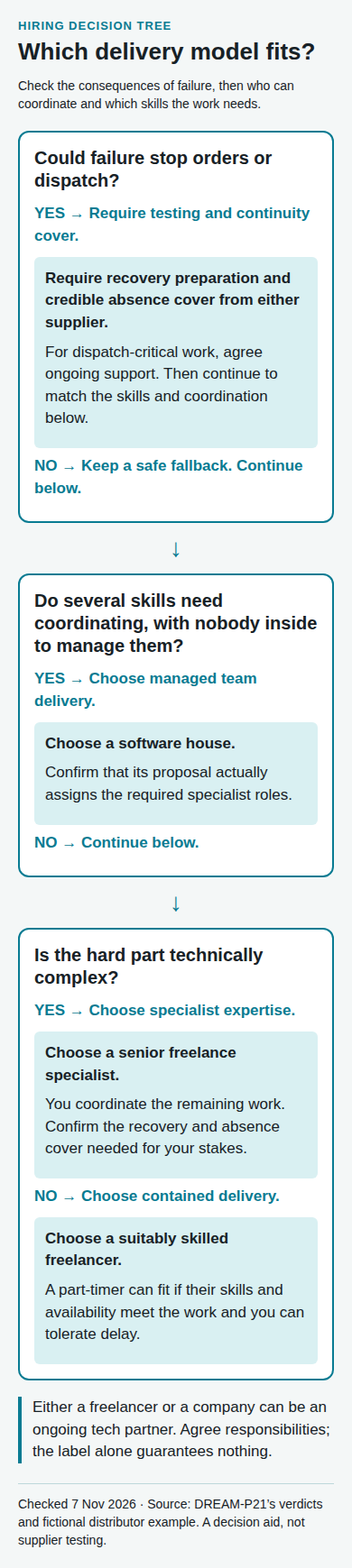
Decision aid based on the article’s hiring guidance.
Ask every supplier these five questions
Get written answers tied to your workflow.
- Who decides scope? Keep authority over priorities and spending; confirm who investigates uncertain work and gets approval before adding cost.
- Who tests the work? Ask how ordinary orders, shortages, corrections and a failed connection will be tested before staff depend on it.
- Who holds access and documentation? Confirm business-controlled accounts, source files, backups and the instructions a replacement supplier would receive.
- Who covers absence? Ask who can take over, whether they have access and knowledge, and what happens if a problem occurs outside support hours.
- Who handles delays and incidents? Ask how a missed milestone is reported, who restores a failed workflow, and how recovery differs from a paid feature change.
Choose for the consequences you face
Use a capable freelancer for contained work you can oversee; use a senior specialist for difficult work within their expertise. Choose a software house when coordinated delivery fills a gap you cannot cover. For costly failure or delay, insist on testing and continuity from whichever supplier you select.
Keep an internal owner for priorities and adoption. For AI-enabled workflows, read why AI projects can fail at adoption.
Dreamcode’s custom solutions service combines product framing, systems engineering and responsible handover. Assess its proposal against the same complexity, disruption and budget questions; confirm support rather than assuming it is included.
Bring your workflow, RM budget and the consequences of delay to a free consultation.
Sources
- Secure Software Development Framework (SSDF), Version 1.1 — National Institute of Standards and Technology. Checked 7 Nov 2026.