On this page
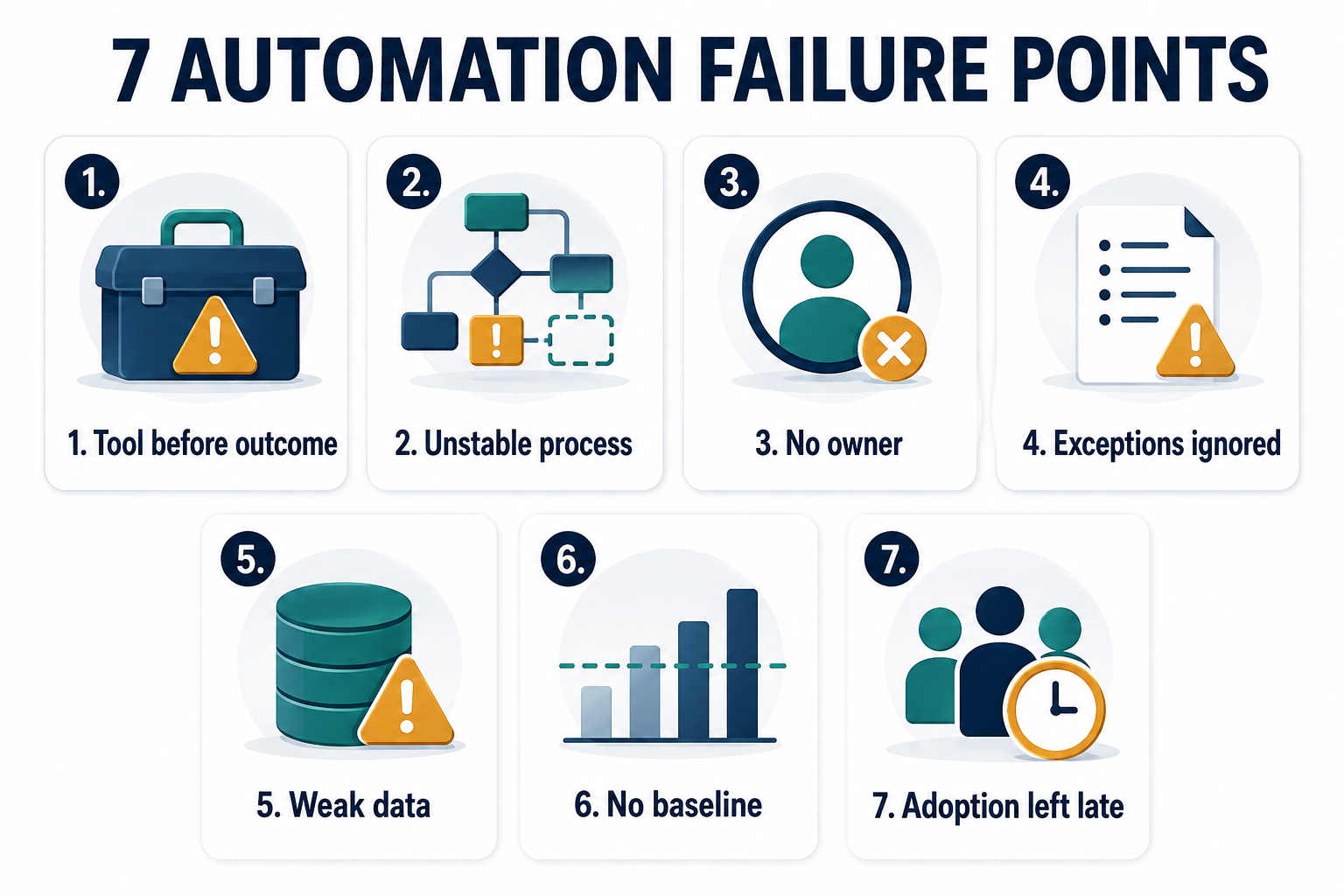
- 1. The team starts with a tool instead of an outcome
- 2. The current process is unstable
- 3. Nobody owns the workflow end to end
- 4. Exceptions are treated as edge cases
- 5. The data cannot support the promised decision
- 6. Success is measured by launch
- 7. Adoption is left until the end
- A pre-build readiness check
- What a healthy first release looks like
- FAQ
- What is the most common reason automation fails?
- Should we automate a process before improving it?
- How much exception handling is enough?
- How long should a pilot run?
- Can a failed automation be rescued?
- Make the first release smaller.
Automation projects usually fail because the team automates an unclear process, ignores exceptions, or launches without an owner—not because the connector or model was technically impossible.
The warning signs appear before development. Find them early and the project becomes smaller, safer, and easier to measure.
Quick answer: define one workflow, one owner, one measurable outcome, and one exception path before building. If those four things are unclear, the automation is not ready.

1. The team starts with a tool instead of an outcome
“We need an AI agent” or “we should automate this department” skips the most important question: what should become better?
Without a specific outcome, scope expands around whatever the tool can do. The demo may look impressive while the operational problem remains.
Fix it: write one outcome in measurable language. Examples include reducing response time, removing duplicate entry, shortening approval cycles, or lowering rework.
2. The current process is unstable
Automation encodes rules. If staff use different rules, the policy changes weekly, or nobody can describe the normal path, development becomes a series of arguments hidden inside tickets.
The result is either a brittle system or a complex one that tries to support every historical variation.
Fix it: map the current path, agree on the future path, and separate common cases from exceptions. Improve the process before automating it.
3. Nobody owns the workflow end to end
Different teams may own individual steps while nobody owns the total outcome. When the automation reaches a gap, each team assumes another team will resolve it.
Technical ownership is not enough. The workflow needs a business owner who can decide priorities, rules, acceptable risk, and exception handling.
Fix it: name one accountable workflow owner and define who can approve changes after launch.
4. Exceptions are treated as edge cases
The happy path is easy to automate. The real work appears when information is missing, a customer asks for something unusual, two systems disagree, or a policy conflicts with the request.
If exceptions are ignored, staff create side channels and spreadsheets to keep work moving. The official automation then covers only the cleanest fraction of reality.
Fix it: list the top exception categories, assign an owner, design a review queue, and record the resolution.
5. The data cannot support the promised decision
An AI or automation workflow is constrained by the information it can reliably access. Poor identifiers, duplicate records, incomplete fields, outdated documents, and restricted systems will surface during implementation.
This does not always mean a long data project is required. It means the scope must match the evidence available.
Fix it: test with real examples early. Document source systems, data quality, access rules, and the minimum information needed for each action.
6. Success is measured by launch
“The workflow went live” is a delivery milestone, not a business result.
Without a baseline, the team cannot tell whether automation reduced time or simply moved work into monitoring and cleanup.
Fix it: record before-and-after measures such as cycle time, manual touches, response time, exception rate, rework, and review effort.
7. Adoption is left until the end
People avoid systems they do not trust, understand, or see as useful. They may keep using the old spreadsheet, bypass a required step, or double-check every automated result manually.
That behaviour is often rational. If users were not involved in design, the new workflow may hide context or make exceptions harder.
Fix it: include frontline users in mapping and testing. Explain what changes, show how exceptions work, and give the team a feedback path after launch.
A pre-build readiness check
Before development starts, confirm:
- Outcome: one operational result is defined
- Scope: one workflow has a clear start and finish
- Owner: one person can make business decisions
- Rules: the normal path is stable enough to describe
- Exceptions: common failures have routes and owners
- Data: required information is accessible and testable
- Measurement: a baseline and target exist
- Adoption: real users will take part in testing
If several items are missing, the next deliverable should be discovery—not production automation.
For a structured assessment, see Dreamcode’s enterprise automation service or begin with an AI consultation. For a practical first step, identify what to automate first.
What a healthy first release looks like
A good first release is intentionally narrow. It handles one valuable path, surfaces rather than hides uncertainty, and creates evidence for the next decision.
It should include:
- A defined trigger and completion state
- Validation before important actions
- An exception route
- Logging and monitoring
- A rollback or manual fallback
- A review date based on real usage
The goal is not to automate the maximum amount of work. It is to establish a dependable operating pattern.
FAQ
What is the most common reason automation fails?
An unclear process with unclear ownership. Technology cannot resolve a business decision that nobody is authorised to make.
Should we automate a process before improving it?
Usually no. Remove unnecessary steps and agree on the target workflow first.
How much exception handling is enough?
Cover the frequent and high-impact exceptions first. Log unexpected cases so the design can improve from evidence.
How long should a pilot run?
Long enough to include normal volume and meaningful exceptions. Define the review point and success criteria before launch.
Can a failed automation be rescued?
Often yes. Narrow the scope, restore a manual fallback, inspect exception data, and decide whether the problem is process, data, adoption, or implementation.
Make the first release smaller.
If an automation project feels larger every time the team discusses it, bring Dreamcode one real workflow. We can help isolate the failure points and define a smaller first release.