On this page
- Why teams confuse the two
- Head-to-head comparison
- 1. The question each service answers
- 2. What you need before starting
- 3. Typical deliverables
- 4. How success is measured
- When AI consultation is the right first move
- When enterprise automation is the right first move
- When you need both
- A five-question decision test
- Common buying mistakes
- Buying AI before defining the job
- Automating a broken process
- Treating consultation as the final product
- Treating automation as a one-time build
- FAQ
- Is AI consultation only for large companies?
- Does enterprise automation always use AI?
- Can consultation include a prototype?
- Which service is cheaper?
- What if we do not know which one we need?
- Ready to choose the right first move?
AI consultation helps you decide where AI belongs, what risks matter, and what to test first. Enterprise automation helps you redesign and connect a known workflow so work moves reliably between people and systems.
The simplest distinction is this: choose consultation when the decision is unclear; choose automation when the workflow is clear but the execution is slow, fragmented, or manual.
Quick answer: If you are asking “Should we use AI here?”, start with AI consultation. If you are asking “Why are we still copying this between three systems?”, start with enterprise automation. If both questions are true, discovery should come first and implementation second.
Why teams confuse the two
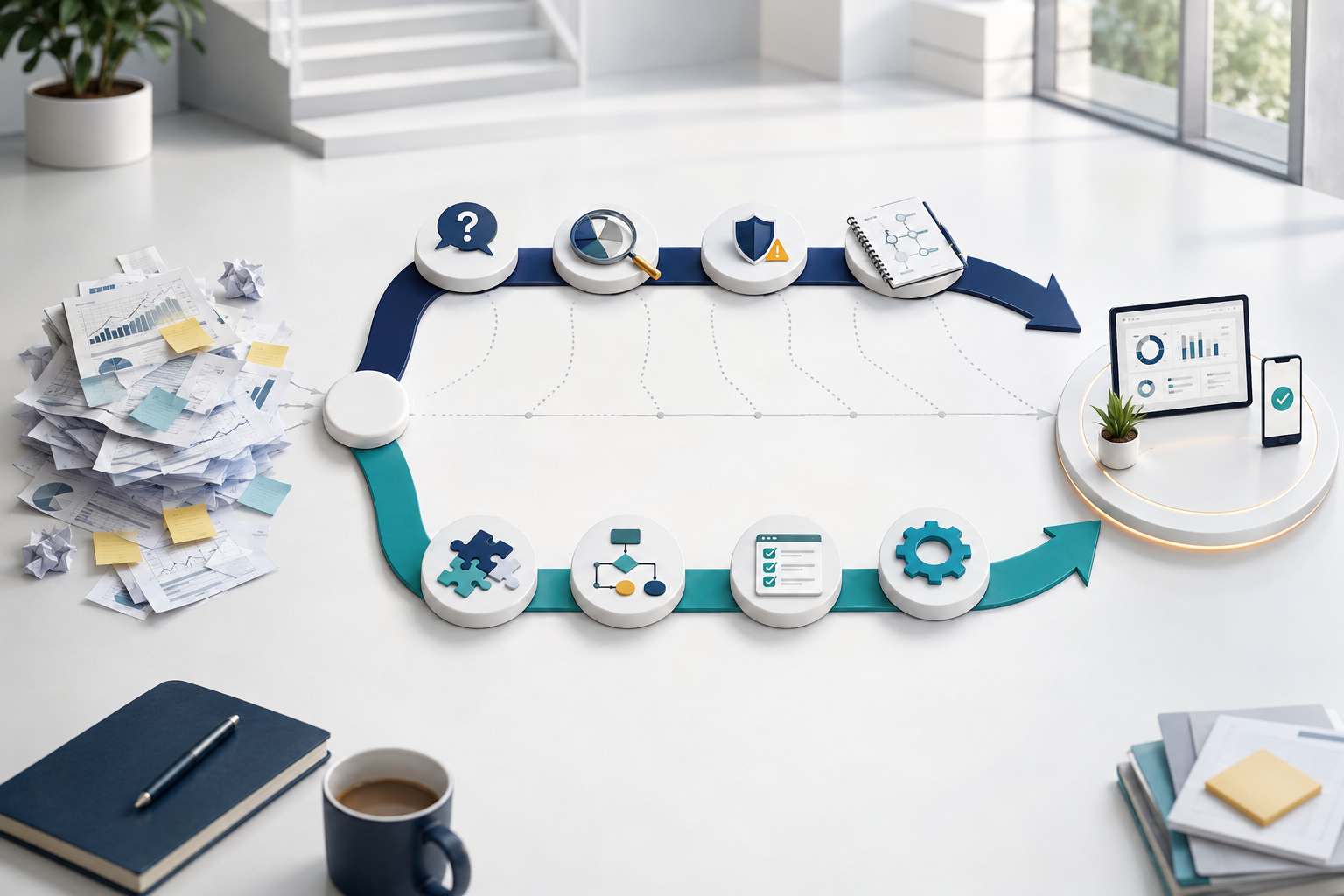
Both services promise better operations. Both may involve AI, integrations, data, and custom software. But they solve different kinds of uncertainty.
AI consultation is primarily a decision and design engagement. It identifies viable use cases, constraints, data needs, review points, and a sensible roadmap.
Enterprise automation is primarily an implementation and operating-system engagement. It connects tools, removes duplicate work, routes information, records decisions, and makes exceptions visible.
Confusing the two creates predictable problems. A team may build automation before agreeing on the process, or spend months discussing AI when a straightforward integration would solve the problem.
Head-to-head comparison
1. The question each service answers
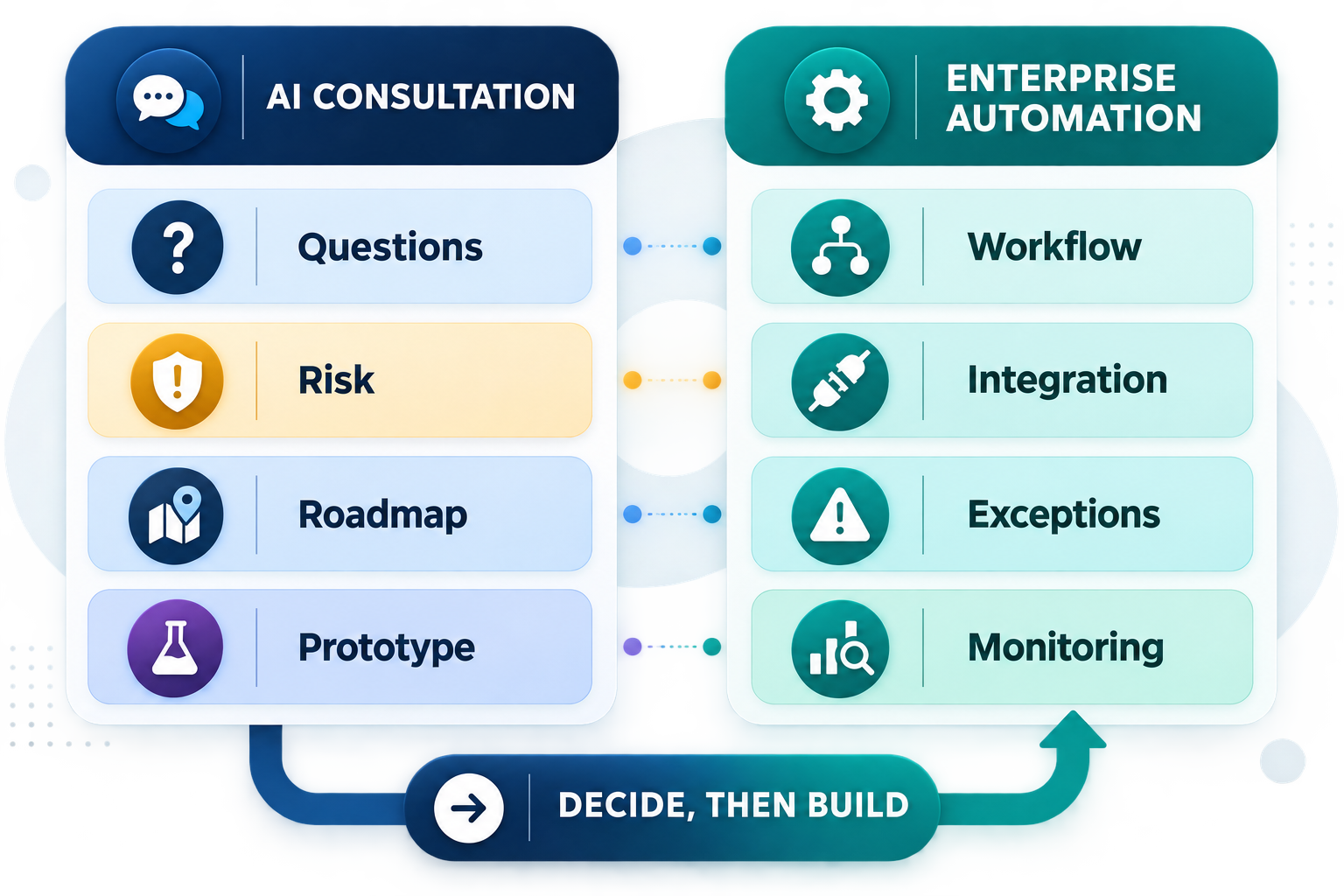
AI consultation asks:
- Where could AI create useful leverage?
- Which use cases are safe enough to test?
- What data and governance are required?
- What should remain human-led?
- What is the smallest useful experiment?
Enterprise automation asks:
- Where does work stall or get re-entered?
- Which systems should exchange information?
- What rules can run automatically?
- Who handles exceptions?
- How will the new workflow be monitored?
Best fit: consultation for strategic uncertainty; automation for operational friction.
2. What you need before starting
AI consultation can begin with a business goal, a painful process, and access to the people who understand the work. The process does not need to be fully defined because defining the opportunity is part of the engagement.
Automation needs a more stable starting point. The trigger, main path, systems, owners, and common exceptions should be understandable. If the workflow changes every week, implementation will encode confusion.
Best fit: consultation when the problem is still being framed; automation when the workflow can be mapped.
3. Typical deliverables
An AI consultation may produce:
- Use-case shortlist
- Readiness and risk assessment
- Data and integration requirements
- Human-review design
- Prototype or proof-of-concept plan
- Prioritised implementation roadmap
An enterprise automation project may produce:
- Current- and future-state workflow maps
- System integrations
- Automated routing and notifications
- Validation and approval rules
- Exception queues
- Monitoring, documentation, and handover
Best fit: consultation for clarity and sequencing; automation for a working production process.
4. How success is measured
Consultation succeeds when the business can make a better investment decision. Useful measures include the number of viable use cases identified, risks resolved, prototype results, and clarity on the next move.
Automation succeeds when the workflow performs better. Useful measures include cycle time, response time, rework, error rate, exception volume, and manual touches per case.
Best fit: consultation for decision quality; automation for operating performance.
When AI consultation is the right first move
Start with AI consultation when:
- Leadership wants an AI roadmap but teams disagree on priorities
- You have several possible use cases and need to rank them
- The work involves judgment, language, or unstructured information
- Data access, privacy, or review requirements are unclear
- You need a controlled experiment before funding a build
- The team is at risk of buying tools before defining the problem
The output should not be a generic presentation. It should narrow the field and make the next decision easier.
When enterprise automation is the right first move
Start with automation when:
- Staff repeatedly copy information between systems
- Requests wait in inboxes or spreadsheets
- Ownership becomes unclear after a handoff
- Rules are stable but execution is inconsistent
- Customers wait because internal work is fragmented
- You can name the trigger, output, and exception owner
AI may still appear inside the workflow, but it does not need to be the centre of the project.
When you need both
Many worthwhile projects need both services in sequence.
Imagine a company wants to process incoming documents with AI. Consultation determines:
- Which document types are suitable
- What accuracy is acceptable
- Which fields require validation
- When a human must review the output
- Whether the expected value justifies a pilot
Automation then connects the production flow:
- Receive the document
- Extract and validate information
- Route exceptions for review
- Update the system of record
- Log the result and notify the owner
Consultation reduces the risk of building the wrong thing. Automation turns the approved design into repeatable work.
A five-question decision test
Ask these questions before choosing a service:
- Is the business decision clear? If not, consultation.
- Can the workflow be mapped today? If yes, automation may be ready.
- Does the task require interpretation? If yes, assess AI and human review.
- Is the biggest pain uncertainty or manual execution? Choose accordingly.
- Can success be measured? Define the metric before either engagement.
Common buying mistakes
Buying AI before defining the job
“We need an AI agent” is a technology preference, not a business requirement. Start with the outcome and the acceptable level of risk.
Automating a broken process
If nobody agrees on ownership, rules, or exceptions, automation will make the disagreement run faster.
Treating consultation as the final product
Strategy is useful only when it produces a decision, experiment, or roadmap that someone owns.
Treating automation as a one-time build
Production workflows need monitoring, documentation, and a clear process for changes. A silent integration is not a durable operating system.
FAQ
Is AI consultation only for large companies?
No. Smaller teams can benefit when they need to avoid an expensive wrong turn or prioritise limited implementation capacity.
Does enterprise automation always use AI?
No. Many valuable automations use rules, APIs, forms, databases, and notifications without an AI model.
Can consultation include a prototype?
Yes. A focused prototype can test feasibility, quality, latency, review effort, or user adoption before a full build.
Which service is cheaper?
That depends on scope. Consultation is usually narrower because it buys clarity; automation includes design, implementation, testing, and handover. Compare the cost of the engagement with the cost of making the wrong decision or keeping the manual process.
What if we do not know which one we need?
Bring one real workflow and the outcome you want. A short discovery session should reveal whether the next move is diagnosis, automation, custom software, or no build at all.
Ready to choose the right first move?
If you are choosing between AI strategy and workflow implementation, show us the process that is causing friction. Dreamcode can help define the right first move before you commit to a large build.